






By Dr. Ben Lynch, ND Bestselling Author of Dirty Genes | Founder, Seeking Health
Key takeaways
- DAO (diamine oxidase) is the primary enzyme that breaks down histamine in your gut. When it underperforms, histamine builds up faster than your body can clear it.
- You can inherit a less functional DAO gene, or you can "dirty" it through gut damage, medications, infections, poor diet, and chronic stress.
- "Reacting to everything" is not random sensitivity. It is a histamine clearance problem, and DAO sits at the center of it.
- Histamine load is cumulative. One glass of wine may be fine. Wine plus leftovers plus poor sleep plus pollen season overflows your bucket.
- DAO depends on a healthy gut lining, good bile flow, and adequate copper and calcium. Supplements alone will not work if these foundations are broken.
- Three products address the histamine problem at different points: DAO Enzyme (mealtime clearance), ProBiota HistaminX (microbiome reshaping), and Histamine Nutrients (breakdown support).†
- Your genes are not your sentence. Lifestyle, diet, and targeted support can restore DAO function and widen your tolerance threshold significantly.

You eat the same meal. They feel fine. You do not.
You and your friend order the same sushi platter. Same fish. Same restaurant. Same evening.
Two hours later, your face is flushed. You are itching. Your gut is cramping. Your head is starting to pound.
Your friend is asking where you want to get dessert.
In your head, you say, “That’s not happening.”
This is not food poisoning. It is not anxiety. It is not "just how your body is."
It is histamine. And it is a clearance problem your doctor has almost certainly never tested for.
Your body produces and receives histamine constantly. It is not a bad molecule. In the right amounts, histamine regulates your immune response, stomach acid, sleep-wake cycles, and gut motility.¹ The problem is not histamine itself. The problem is what happens when your body cannot break it down fast enough.
That breakdown depends almost entirely on one enzyme: diamine oxidase, or DAO.
When DAO is underperforming, histamine accumulates. Every meal, every glass of wine, every stressful day, every plate of leftovers adds more to the pile. Eventually, you cross a threshold, and your system starts acting like the entire world is toxic.
What DAO actually does
DAO is the enzyme responsible for breaking down extracellular histamine in your gut.²
It is produced mainly in the small intestine, colon, kidneys, and placenta. When you eat food that contains histamine or food that triggers histamine release, DAO is your first line of defense. It intercepts histamine in your gut before it crosses into your bloodstream.

When DAO is working well, you have a wide margin. You can eat aged cheese, have a glass of wine, eat leftovers from three nights ago, and feel nothing unusual.
When DAO is struggling, that margin collapses. Suddenly, foods you have always tolerated start causing reactions. You are not becoming more sensitive. Your clearance is deteriorating.
Think of it as a ‘Histamine Bucket'.
The faucet is everything that adds histamine to your system: fermented foods, aged meats and cheese, alcohol, leftovers, histamine-producing gut bacteria, and your own immune system releasing histamine in response to infections, allergens, and irritants.
The drain is everything that clears it: DAO in your gut, methylation pathways, liver detoxification, and supporting clearance enzymes.
Your bucket is your personal tolerance threshold. At 60 percent full, you feel fine. At 90 percent, one trigger overflows it.

Most people with histamine problems are not pouring more into the sink than anyone else. They have a partially blocked drain. The people who struggle most have a severely blocked one.
Supporting DAO means opening that drain.†
The DAO pattern: do you see yourself in this?
You do not need a genetic test or an expensive lab test to suspect a DAO problem. Your history tells the story.
Common DAO clues:
- Reactions to wine, beer, aged cheese, fermented foods, or leftovers that others do not share
- Frequent itching, flushing, or hives without an obvious allergen
- Skin that stays red longer than normal when scratched
- Headaches or migraines that track with food or drink, not stress
- Heartburn or reflux that does not resolve fully with antacids
- Loose stools, urgency, or cramping that does not match a clean IBS diagnosis
- Symptoms that worsen around hormonal shifts, such as cycle changes, perimenopause, postpartum
- Low blood pressure (near or below 100/60) with dizziness on standing
- Sleep problems characterized by difficulty staying asleep or "tired but wired" nights
- Joint pain that flares with specific foods
- Being able to tolerate more histamine-containing foods while pregnant.
- A history of reacting badly to histamine-producing probiotics (Lactobacillus acidophilus, L. casei, L. reuteri, L. bulgaricus, L. fermentum, Streptococcus thermophilus)³
If you have cycled through elimination diets, failed food sensitivity testing, or built an elaborate "safe foods" list over the years, DAO is almost certainly part of your story.
DAO genetic variants: what the research shows
DAO is encoded by the AOC1 gene (also called ABP1). Several well-studied variants reduce enzyme activity.
| rsID | Gene | Variant | Ethnicity Prevalence | Functional Consequence | Status |
|---|---|---|---|---|---|
| rs2052129 | AOC1 | C allele | ~30% European population⁴ | Reduces DAO expression in intestinal epithelium⁴ | Dirty |
| rs1049793 | AOC1 | T allele | ~15% European population⁵ | Reduces DAO enzyme activity by approximately 30%⁵ | Dirty |
| rs10156191 | AOC1 | T allele | Prevalence data limited | Associated with reduced DAO activity; studied in migraine cohorts⁶ | Dirty |
Having one of these variants does not guarantee symptoms. Lifestyle, gut health, and nutrient status determine how much these SNPs actually cost you.
Not everyone with DAO symptoms carries a variant. A normal AOC1 gene can still produce low DAO output if the gut lining is damaged, copper is depleted, methylation is impaired, or medications are blocking the enzyme.⁷
This is why StrateGene is useful here. Seeing your actual AOC1 variants in the context of your full gene network, including MTHFR, COMT, and MAOA, shows you which parts of histamine clearance need the most attention. View your StrateGene report.
Another thing to be aware of is that these variants work synergistically. The three variants have a greater impact on DAO enzyme activity when they appear together than when they act individually. The combination of variants is called a ‘Haplotype’ and provides much more accurate information on how your DAO enzyme is actually working. For this reason, the StrateGene Histamine report reports the DAO haplotype rather than the individual variants.
How DAO gets dirty: the real causes
Born with a reduced-function variant is one path. But most people with DAO problems have layered multiple acquired stressors onto an otherwise functional gene.
The major DAO disruptors:
Gut damage and leaky gut suppress DAO production directly because the intestinal epithelium is where DAO is made.⁷ Damaged villi produce less enzyme. This is why people with celiac disease, inflammatory bowel conditions, and a history of antibiotic overuse often develop histamine problems later.
Medications block DAO or increase histamine load. This includes many common antidepressants, antihistamines (paradoxically), NSAIDs, metformin, antacids, and alcohol.3, ⁸ If reactions started after starting a medication, the medication is a legitimate suspect.
Methylation problems, especially MTHFR variants, reduce the activity of histamine N-methyltransferase (HNMT), the enzyme that clears histamine inside cells.⁹ When HNMT is slow, more pressure falls on DAO. Dirty MTHFR and dirty DAO often worsen each other.
SIBO and Candida overgrowth ramp up histamine production from gut bacteria while simultaneously damaging the intestinal lining that produces DAO.¹⁰ Treating SIBO without addressing histamine is a common reason people feel temporarily worse on treatment.
A high-histamine diet stacks incoming histamine faster than even a healthy DAO can clear. Alcohol inhibits DAO directly while also being high in histamine.¹¹ Fermented foods and aged meats add the most histamine per gram.
Chronic stress and poor sleep keep histamine elevated through cortisol-histamine crosstalk and mast cell activation.¹² DAO cannot win against a system running in constant emergency mode.
Copper deficiency matters because DAO is a copper-dependent enzyme. Low copper reduces DAO activity even when the gene is clean.¹³

What a dirty DAO drives over time
A chronically overworked DAO pathway does not just cause annoying reactions. It can participate in persistent conditions.
Patterns associated with low DAO activity include:
Gut: chronic loose stools, urgency, cramping, SIBO, irritable bowel patterns that do not resolve with standard treatment⁷
Head: migraines, headaches tied to food and wine, dizziness, vertigo, motion sickness worse than peers⁶
Skin: hives, flushing, chronic itch, contact urticaria, delayed skin redness after scratching
Respiratory: nasal congestion, sneezing, tight chest, air hunger tied to exposures
Cardiovascular: low blood pressure, racing heart after meals, dizziness on standing²
Sleep and mood: nighttime wakefulness, restlessness, "tired but wired" pattern, irritability that tracks with food
These are not separate diagnoses. They are one overloaded histamine clearance system expressing itself across multiple tissues simultaneously.
Foundations before supplements
The supplement stack does nothing supportive if the underlying inputs are still overwhelming the system. Start here.
1. Reduce incoming histamine
The highest-histamine foods per gram consumed include alcohol (especially wine and beer), fermented foods (sauerkraut, kimchi, kombucha), aged cheeses, cured and processed meats, canned fish, and leftovers stored more than 24 hours.¹¹ You do not need to eliminate these permanently. While DAO is struggling, treat them as occasional choices rather than daily staples.
2. Repair your gut
DAO is produced in the intestinal epithelium. A damaged gut lining means less DAO regardless of what else you do. Gut Nutrients provides the core building blocks your intestinal lining needs to rebuild and maintain integrity.†
3. Support bile flow
Healthy bile flow keeps fats moving, supports microbial balance, and reduces the conditions that allow histamine-producing bacteria to thrive. Bile Nutrients supports healthy bile production and flow.†
4. Prioritize sleep
DAO and histamine are tightly coupled to circadian rhythm. Poor sleep raises histamine. Elevated histamine disrupts sleep. Breaking this cycle requires treating sleep as a core intervention, not an afterthought. Optimal Magnesium before bed supports healthy sleep.†
5. Feed DAO what it needs
DAO requires copper and functions best in an alkaline-leaning gut environment. Copper-rich foods include beef liver, sunflower seeds, almonds, lentils, and asparagus. Calcium-rich alkaline foods like kale, bok choy, watercress, and broccoli support the gut environment where DAO works.¹³,16
The three products for DAO support
If you are supporting DAO function, these three products address the problem at different points in the pathway.†
DAO Enzyme — mealtime clearance support†
DAO Enzyme provides supplemental diamine oxidase, taken before or with meals that are higher in histamine. It temporarily opens the drain wider at the gut level so less histamine from that meal enters circulation.This is your in-the-moment tool for restaurant meals, travel, social events, and situations where food control is limited.†
This is not a long-term fix on its own. It is a safety net while deeper work proceeds.†

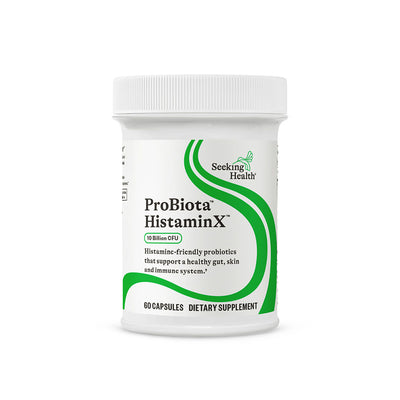
ProBiota HistaminX — long-term microbiome support†
ProBiota HistaminX is a probiotic formula assembled specifically to exclude histamine-producing strains (L. acidophilus, L. casei, L. reuteri, L. bulgaricus) while including strains that support a healthy histamine response.³ It works at the faucet level, supporting how much histamine your gut bacteria produce day after day.†
This product requires patience. Microbiome remodeling takes weeks to months. It is the foundational investment that changes your baseline.
Take 1 capsule in the morning upon waking.

Histamine Nutrients — cofactor support for histamine breakdown†
Histamine Nutrients provides the key cofactors your body uses to break down histamine, including copper, SAMe, vitamin B6 as P-5-P, and vitamin C. It works at the clearance level, supporting the enzymatic pathways that process histamine after it enters circulation.Use it as ongoing nutritional support for the DAO pathway, particularly if diet alone is not covering these cofactor needs.†

How they work together:
ProBiota HistaminX turns down the everyday faucet. DAO Enzyme widens the drain at mealtime. Histamine Nutrients supports the clearance pathways that process histamine after absorption.†
A practical starting protocol
This is a suggested sequence. Adjust with your practitioner.
Weeks 1 to 2: Cut high-histamine foods and eliminate leftovers stored more than one day. Add Digestive Enzymes with main meals to support protein digestion, therefore reducing the amount of undigested protein available to histamine-producing bacteria.†
Weeks 3 to 4: Work on supporting normal repair of your intestinal lining, where DAO activity happens:Introduce DAO Enzyme with or before higher-histamine meals - to support your own natural DAO enzyme activity. Add ProBiota HistaminX once daily - to help support a healthy gut microbiome†
Sip Gut Nutrients upon waking, 30 minutes before food — for healthy gut lining support†
Take Bile Nutrients before dinner - to support healthy bile production and flow, which helps to support healthy bowel movements and a healthy microbiome in the small intestine.†
Week 5 and beyond: Add Histamine Nutrients if cofactor support is needed or diet is not covering copper, B6, and vitamin C adequately.† Continue diet, sleep, and stress work. Evaluate MTHFR, SIBO, and Candida with your practitioner if symptoms persist.
Signs you have started too aggressively: new loose stools, increased itching or flushing, headaches, or "detoxy" sensations after adding multiple products at once. Step back to one product, stabilize, then add others slowly.
Signs the support is working: calm skin, digestive comfort with simple meals, consistent sleep, less daily reliance on histamine management strategies.†
What you can do starting today
- Remove leftovers stored more than 24 hours from your current meal rotation.
- Eliminate alcohol for two weeks and document whether symptoms shift.
- Add DAO Enzyme before your next higher-histamine meal.†
- Assess your sleep quality as a histamine variable, not just a comfort issue.
- Start ProBiota HistaminX as your daily histamine-aware probiotic foundation.†
- If you have a StrateGene Histamine Report, review your AOC1, COMT, MAOA, ALDH and MTHFR variants together. They interact.
- Work with a practitioner on SIBO, Candida, or gut lining repair if the foundations above do not move the needle.
The bottom line
Reacting to everything is not a character flaw or a mystery. It is what life looks like when histamine is accumulating faster than your body can clear it and DAO has been working without backup for too long.
Cleaning up incoming histamine, rebuilding the gut environment where DAO lives, and using targeted support at the right points in the pathway gives your system a real chance to recover its range.
Your genes are not a sentence. They are a starting point.
Frequently asked questions about DAO enzyme and histamine
What is DAO deficiency?
DAO deficiency means your diamine oxidase enzyme is not clearing histamine from your gut efficiently. This can result from inherited AOC1 gene variants, gut damage, copper deficiency, medications, or bacterial overgrowth. The result is histamine buildup after meals, producing symptoms across the gut, skin, head, and respiratory system.
Can you test for DAO deficiency?
Yes. Serum DAO activity can be measured through specialty labs but it’s not that accurate. Low serum DAO levels (below 3 U/mL in some reference ranges) suggest impaired clearance capacity. Gene testing through the StrateGene Histamine Report can identify AOC1 variants that reduce enzyme expression or activity. Neither test alone gives a complete picture.
What foods are highest in histamine?
The highest-histamine foods include aged cheeses, fermented foods (sauerkraut, kimchi, kombucha), cured and smoked meats, alcohol (especially red wine and beer), canned fish, and leftovers stored more than 24 hours. Fresh-cooked food from fresh ingredients is almost always lower in histamine.
Can probiotics make histamine problems worse?
Yes. Several probiotic strains produce histamine as a metabolic byproduct. Lactobacillus acidophilus, L. casei, L. reuteri, and L. bulgaricus are the most studied.³ If you have reacted poorly to probiotics, this is likely the reason. ProBiota HistaminX is formulated specifically to exclude these strains.†
How long does DAO support take to work?
DAO Enzyme works immediately at mealtime when taken before the meal. ProBiota HistaminX may require weeks to support healthy microbiome composition and baseline histamine load. Most people notice meaningful change in one to four weeks with consistent use combined with dietary changes.†
Does histamine interact with hormones?
Yes. Estrogen stimulates histamine release from mast cells, and histamine stimulates estrogen production.¹⁴ This creates a feedback loop that explains why many people with dirty DAO notice symptoms worsen around ovulation, the premenstrual window, perimenopause, or postpartum. This pattern is not exclusive to women. Testosterone metabolism also intersects with histamine clearance through shared enzyme pathways.
What foods increase DAO enzyme activity?
No food contains DAO directly. But several nutrients support DAO production and activity. Copper is the most critical: DAO is a copper-dependent enzyme, and copper deficiency reduces its output regardless of gene status.¹³ Good dietary copper sources include beef liver, sunflower seeds, almonds, lentils, and asparagus. Vitamin B6 (as pyridoxal-5-phosphate) and vitamin C also support histamine clearance pathways.¹⁵ An alkaline-leaning diet that includes broccoli, kale, watercress, bok choy, zucchini, and artichokes supports the gut environment where DAO works. Fresh, unprocessed food in general is lower in histamine and places less burden on the enzyme.
Can you fix DAO permanently?
You can significantly restore DAO output and widen your tolerance threshold. Repairing gut lining, correcting copper status, addressing methylation, clearing SIBO, and removing medications that block DAO can all substantially improve clearance over time. The underlying AOC1 variant, if present, does not change, but you can largely compensate for it with a consistent lifestyle and targeted support.
Seeking Health products to consider
- DAO Enzyme — supplemental diamine oxidase for mealtime histamine clearance†
- ProBiota HistaminX — probiotic formula for long-term healthy histamine response support†
- Histamine Nutrients — cofactor support (copper, B6, vitamin C) for enzymatic histamine breakdown†
- Gut Nutrients — gut lining support for the intestinal environment where DAO is produced†
- Bile Nutrients - bile production and flow to support healthy bowel movements, and a healthy microbiome in the small intestine.†
- Digestive Enzymes — protein and carbohydrate digestion support to reduce substrate for histamine-producing bacteria†
References
- Maintz L, Novak N. Histamine and histamine intolerance. Am J Clin Nutr. 2007;85(5):1185-1196. PMID: 17490952. https://pubmed.ncbi.nlm.nih.gov/17490952/
- Kovacova-Hanuskova E, Buday T, Gavliakova S, Plevkova J. Histamine, histamine intoxication and intolerance. Allergol Immunopathol (Madr). 2015;43(5):498-506. PMID: 25174736. https://pubmed.ncbi.nlm.nih.gov/26242570/
- Hrubisko M, Danis R, Huorka M, Wawruch M. Histamine Intolerance-the More We Know the Less We Know. A Review. Nutrients. 2021;13(7):2228. doi:10.3390/nu13072228. PMID: 34209583. PMCID: PMC8308327.
- Schwelberger HG. The origin of mammalian plasma amine oxidase. J Neural Transm (Vienna). 2007;114(6):757-762. PMID: 17417784. https://pubmed.ncbi.nlm.nih.gov/17385066/
- Petersen J, et al. Genetic variations of the histamine degrading enzymes diamine oxidase and histamine N-methyltransferase risk factors for migraine and histamine intolerance. J Neural Transm. 2019;126(12):1523-1534. PMID: 31667638. https://pubmed.ncbi.nlm.nih.gov/31667638/
- Meza-Velazquez R, et al. Association of diamine oxidase and histamine N-methyltransferase polymorphisms with presence of migraine in a group of Mexican mothers and children. Neurologia. 2017;32(8):500-507. PMID: 26750432. https://pubmed.ncbi.nlm.nih.gov/27130307/
- Raithel M, et al. The involvement of the histamine degradation pathway by diamine oxidase in manifest gastrointestinal diseases. Inflamm Res. 2005;54 Suppl 1:S90-1. PMID: 15928897. https://pubmed.ncbi.nlm.nih.gov/10350171/
- Yee SW, Lin L, Merski M, Engkvist O, Fedorov O, Schiöth HB, Bhattacharya A, Giacomini KM. Prediction and validation of enzyme and transporter off-targets for metformin. J Pharmacokinet Pharmacodyn. 2015;42(5):463-75. doi:10.1007/s10928-015-9436-y. PMID: 26335661.
- Komericki P, et al. Histamine intolerance: lack of reproducibility of single symptoms by oral provocation with histamine: a randomised, double-blind, placebo-controlled cross-over study. Wien Klin Wochenschr. 2011;123(1-2):15-20. PMID: 21170660. https://pubmed.ncbi.nlm.nih.gov/21165702/
- Schink M, et al. Microbial patterns in patients with histamine intolerance. J Physiol Pharmacol. 2018;69(4). PMID: 30571591. https://pubmed.ncbi.nlm.nih.gov/30552302/
- Lin CS, Kung HF, Lin CM, Tsai HC, Tsai YH. Histamine production by Raoultella ornithinolytica in mahi-mahi meat at various storage temperatures. J Food Drug Anal. 2016;24(2):305-310. doi:10.1016/j.jfda.2014.06.010
- Elenkov IJ, Webster EL, Torpy DJ, Chrousos GP. Stress, corticotropin-releasing hormone, glucocorticoids, and the immune/inflammatory response: acute and chronic effects. Ann N Y Acad Sci. 1999;876:1-11; discussion 11-3. doi:10.1111/j.1749-6632.1999.tb07618.x. PMID: 10415589
- Shepard EM, Dooley DM. Inhibition and oxygen activation in copper amine oxidases. Acc Chem Res. 2015;48(5):1218-26. doi:10.1021/ar500460z. PMID: 25897668.
- Bonds RS, Midoro-Horiuti T. Estrogen effects in allergy and asthma. Curr Opin Allergy Clin Immunol. 2013;13(1):92-99. PMID: 23111421. https://pmc.ncbi.nlm.nih.gov/articles/PMC3537328/
- Maintz L, et al. Evidence for a reduced histamine degradation capacity in a subgroup of patients with atopic eczema. J Allergy Clin Immunol. 2006;117(5):1106-1112. PMID: 16675338. https://pubmed.ncbi.nlm.nih.gov/16675338/
- McGrath AP, Hilmer KM, Collyer CA, Dooley DM, Guss JM. A new crystal form of human diamine oxidase. Acta Crystallogr Sect F Struct Biol Cryst Commun. 2010;66(Pt 2):137-42. doi:10.1107/S1744309109052130. PMID: 20124708; PMCID: PMC2815678.
†These statements have not been evaluated by the Food and Drug Administration. This product is not intended to diagnose, treat, cure, or prevent any disease.